Most smoke alarms should be replaced when they reach the manufacturer’s expiry or replacement date, which is commonly around ten years after manufacture. You should also replace an alarm sooner if it is damaged, fails a regular test, repeatedly gives false alarms or continues to chirp after the battery has been changed.
It is easy to assume that a smoke alarm is working because its indicator light is on or because it responds when the test button is pressed. However, the sensing components inside an alarm can become less reliable as the unit ages.
This applies to battery-operated and mains-powered alarms. A mains electrical connection removes the need to rely solely on a replaceable battery, but it does not prevent the alarm’s internal components from ageing. Essex County Fire and Rescue Service advises replacing smoke alarms every ten years regardless of whether they are mains-wired or battery operated.
Replacing an alarm at the correct time is a relatively simple part of maintaining fire safety in the home. The important step is knowing the age and type of each alarm rather than waiting until it visibly stops working.
How long do smoke alarms usually last?
Many domestic smoke alarms have an expected lifespan of approximately ten years, although the exact period depends on the manufacturer and model.
The replacement or expiry date should take priority over a general rule. Electrical Safety First recommends checking the expiry date and replacing smoke alarms every ten years or when the stated replacement date is reached.
A ten-year alarm is often fitted with a sealed battery intended to last for the expected service life of the unit. When that period ends, the entire alarm is replaced rather than opening it to change the battery.
Other alarms use replaceable batteries. These batteries may need changing much more frequently, but replacing the battery does not reset the age of the alarm itself.
The sensor, electronics and sounder continue to age even when the alarm has received a fresh battery. This means an alarm that is more than ten years old should not normally remain in service simply because it still produces a loud sound when tested.
Always check the instructions printed on the alarm or provided by its manufacturer. Some specialist products may have different service intervals.
How can you tell how old a smoke alarm is?
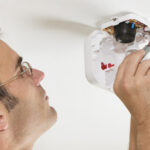
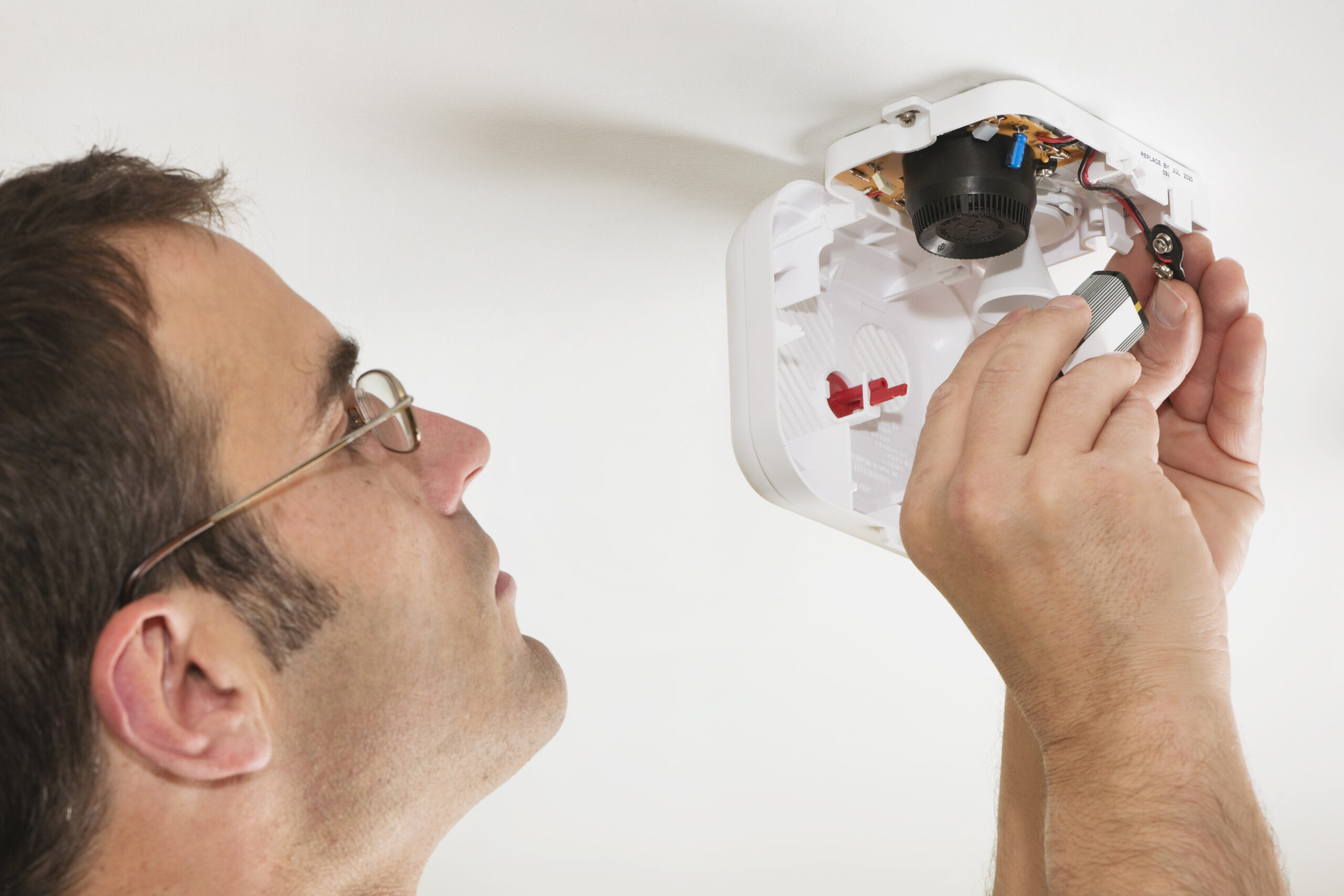
The manufacturing date, installation date or replacement date is usually printed on the rear, side or base of the alarm.
You may need to carefully twist or release the unit from its mounting plate to see this information. Before doing so, check the manufacturer’s instructions, particularly where the alarm is mains-powered or interconnected with other units.
Look for wording such as:
- Manufacture date
- Replace by
- Expiry date
- Do not use after
- Installed on
- Replace alarm by
Where only the manufacturing date is shown, the manufacturer’s stated lifespan can be used to calculate the likely replacement date.
For example, an alarm manufactured in July 2016 with a ten-year service life would generally be due for replacement by July 2026, unless its instructions specify otherwise.
If the date cannot be read, the label is missing or you have no reliable record of when the alarm was installed, replacement may be the safest practical option.
This is especially relevant when moving into an older property. The alarms may appear clean and modern, but you may not know whether they were fitted recently or have been in place for many years.
Recording the installation date of each new alarm can make future maintenance easier. Keep the information with your property records or note the replacement date somewhere accessible.
Should you wait ten years before replacing an alarm?
No. Ten years is commonly the maximum service life rather than a guarantee that every alarm will operate correctly until that date.
An alarm should be replaced sooner when there is evidence that it is damaged, unreliable or unsuitable for its location.
The alarm fails its test
Test the alarm using its test button in accordance with the manufacturer’s instructions.
The UK Government’s home fire safety guidance recommends making alarm testing part of a regular household routine. If the alarm does not sound, the battery may need replacing where the model has a removable battery. If it still does not work after appropriate battery replacement, the alarm should be replaced.
Do not assume that the test button itself is faulty or that the alarm will still respond to smoke.
The casing is damaged
Replace an alarm if its casing is cracked, melted, heavily discoloured or no longer attaches securely to its base.
Physical damage may affect the sensor openings, internal connections or sounder. An alarm that has fallen from a ceiling or been struck during building work may also require replacement.
Do not paint over a smoke alarm. Paint can block the openings needed for smoke to reach the sensor.
The alarm has been contaminated
Dust, insects, grease, paint spray and building debris can interfere with smoke alarms.
Cleaning may resolve minor contamination if it is carried out according to the manufacturer’s instructions. Government guidance recommends vacuuming alarms periodically to remove dust.
However, an alarm heavily affected by decorating materials, kitchen grease, water or construction dust may need replacing.
It gives repeated false alarms
An occasional false alarm may be caused by cooking fumes, steam, dust or an unsuitable position.
Repeated unwanted alarms should not simply be accepted. They can encourage household members to remove batteries, disconnect the unit or ignore future warnings.
The cause may be:
- An unsuitable alarm type
- Poor positioning
- Dust or insect contamination
- Steam from a bathroom
- Cooking fumes
- Electrical interference
- An ageing or defective sensor
Cleaning or repositioning may be appropriate in some circumstances, but persistent false alarms can indicate that the unit needs replacing.
The alarm has been exposed to water
A leak from the room above, severe condensation or direct water contact can damage an alarm.
Do not rely on the unit simply because it appears to dry out and respond to the test button afterwards. Check the manufacturer’s guidance and replace the alarm where there is any doubt about its condition.
It makes unusual sounds
A regular short chirp often indicates a low battery, end-of-life warning or fault.
The meaning varies between manufacturers, so check the instruction manual or markings on the unit.
Where the alarm uses a replaceable battery, fitting the correct fresh battery may resolve the issue. If the alarm continues to chirp, has reached its expiry date or uses a sealed battery, the whole unit may need replacing.
Should you replace an alarm that keeps beeping?
A beeping or chirping alarm should be investigated rather than ignored.
The sound may indicate:
- A low battery
- An incorrectly fitted battery
- The end of the unit’s service life
- Dust inside the alarm
- A fault within the unit
- A problem affecting the mains supply
- A backup battery fault in a mains alarm
Government fire safety guidance advises replacing the battery immediately when a smoke alarm begins to beep regularly. It also advises replacing a ten-year alarm as a complete unit once its ten-year life ends.
Do not permanently silence an alarm by removing its battery.
If a battery-powered alarm continues to chirp after the correct battery has been fitted, check the manufacturer’s reset procedure. Some units retain a small electrical charge and require the test button to be held for a specified period after the old battery is removed.
Where the sound continues, replace the alarm.
With a mains-powered unit, repeated beeping may involve the backup battery, the alarm head or its power supply. An electrician may be needed if the unit cannot be safely removed or if several interconnected alarms are affected.
Do mains-powered smoke alarms need replacing?
Yes. Mains-powered smoke alarms still have a finite service life.
Their electrical supply may continue functioning for decades, but the smoke sensor and internal electronic components do not last indefinitely. Mains alarms may also contain rechargeable or replaceable backup batteries that deteriorate over time.
The alarm head may be designed to detach from a wired base, allowing a compatible replacement to be fitted. However, compatibility should not be assumed.
Different alarm models may use:
- Different bases
- Different wiring arrangements
- Different interconnection signals
- Different backup batteries
- Different sensor technology
- Different manufacturer-specific connectors
Replacing one interconnected alarm with an incompatible model could prevent it from communicating correctly with the others.
Where mains-powered alarms need changing, it is sensible to identify the manufacturer, model and interconnection arrangement before purchasing replacements.
A qualified electrician can check the supply, replace compatible alarm heads or advise whether the system would benefit from a coordinated upgrade.
Should all alarms be replaced at the same time?
Replacing all alarms together can be practical when they were installed at the same time and are approaching the same expiry date.
It gives the property a consistent system and makes future maintenance easier. You can record one installation year and plan the next full replacement accordingly.
A coordinated replacement may be particularly useful where alarms are interconnected. In an interconnected system, activation of one alarm causes the other linked alarms to sound.
This can improve warning throughout the property, especially when a fire begins on a different floor from the bedrooms.
Replacing alarms together may also be advisable when:
- The installation date is unknown.
- Several units are showing age-related faults.
- Existing models are no longer available.
- The alarms do not communicate reliably.
- The property layout has changed.
- A loft conversion or extension has added new rooms.
- The existing system does not provide suitable coverage.
- Different alarm types have been fitted without a clear plan.
However, one recently damaged alarm does not automatically mean that every newer alarm in the property must be replaced. The decision depends on age, compatibility and the wider system design.
What is the difference between smoke and heat alarms?
Smoke alarms and heat alarms detect different signs of fire and are intended for different locations.
A smoke alarm reacts to particles produced by a fire. Depending on its technology, it may be more or less sensitive to certain types of smoke or nuisance sources.
A heat alarm responds when the temperature reaches a specified level or rises rapidly, depending on the model.
Heat alarms are often used in kitchens because ordinary cooking activities can trigger smoke alarms. However, a heat alarm should not automatically replace a smoke alarm elsewhere in the home.
The correct arrangement depends on the property layout and relevant guidance.
Common alarm categories include:
Optical smoke alarms
Optical alarms are generally responsive to slow, smouldering fires. They may be suitable for circulation spaces and living areas, depending on the manufacturer’s instructions.
Heat alarms
Heat alarms are designed for locations where smoke or fumes may cause frequent unwanted activation, such as kitchens.
Multi-sensor alarms
Multi-sensor devices use more than one detection method to assess potential fire conditions. Their suitability varies according to the product and location.
Carbon monoxide alarms
A carbon monoxide alarm detects carbon monoxide rather than smoke or heat. It performs a different function and does not replace a fire alarm.
When replacing an old unit, check that the new product is the correct type for the room rather than selecting one based only on size or price.
How often should smoke alarms be tested?
Smoke alarms should be tested regularly using the test button.
UK Government guidance recommends making this part of the household routine, while several UK fire and electrical safety organisations advise testing weekly or at least monthly.
Testing confirms that the alarm receives power and that its electronic circuit and sounder respond to the test command.
It does not guarantee that every internal component is in perfect condition, which is why the replacement date still matters.
A practical routine is to:
- Warn anyone in the property before testing.
- Press and hold the test button as instructed.
- Confirm that the alarm sounds clearly.
- Check whether linked alarms also activate.
- Investigate any weak, intermittent or silent unit.
- Record problems and arrange replacement promptly.
Never test a smoke alarm using a flame, burning paper or another uncontrolled source of smoke.
How should smoke alarms be maintained?
Maintenance requirements vary between models, so the manufacturer’s guidance should always be followed.
Typical maintenance includes:
- Regular testing
- Replacing removable batteries when required
- Removing dust with a vacuum attachment
- Keeping sensor openings clear
- Checking for visible damage
- Checking the expiry date
- Avoiding paint, sprays and cleaning fluids
- Confirming that interconnected alarms sound together
Government fire safety guidance recommends vacuuming alarms every six months to remove dust. Some fire and rescue services advise cleaning more frequently, depending on the environment.
Do not dismantle the alarm to clean its internal parts unless the manufacturer specifically instructs you to do so.
When should you upgrade rather than replace like for like?
Replacing an expired alarm with the same type may not always be the best solution.
The property and the way it is used may have changed since the original system was installed.
Consider a wider upgrade when:
- A loft has been converted.
- An extension has created a longer escape route.
- Bedrooms have moved to a different floor.
- The existing alarms cannot be heard clearly.
- A resident has hearing difficulties.
- The system is not interconnected.
- Frequent false alarms suggest unsuitable alarm types.
- Mains-powered alarms are incompatible or obsolete.
- The property is being comprehensively rewired.
- The home is being prepared for letting.
An electrician can assess the electrical side of a mains alarm system, including its supply and interconnections.
Fire safety advice may also be available from the local fire and rescue service, particularly where household members are elderly, vulnerable or unable to respond easily to a standard audible alarm.
Can you replace smoke alarms yourself?
Many standalone battery alarms are designed for straightforward domestic installation. The manufacturer’s instructions should be followed carefully, including guidance on position and fixing.
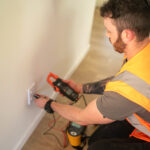
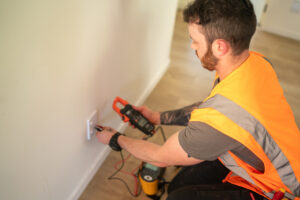
Mains-powered smoke alarms are different because they are connected to the fixed electrical installation.
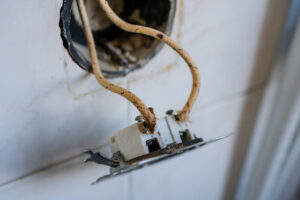
Even where the alarm head appears to twist away from its base, there may be live wiring behind the mounting plate. The replacement unit must also be compatible with the supply and any interconnection system.
Use a qualified electrician where:
- New mains wiring is required.
- The mounting base needs changing.
- The alarm is hard-wired.
- The circuit appears damaged.
- Several alarms need interconnecting.
- The existing system is unreliable.
- You are uncertain about compatibility.
- The alarm circuit trips a protective device.
Electrical work should be completed and tested correctly rather than treating the alarm as an ordinary plug-in appliance.
What should landlords consider when replacing alarms?
Landlords must pay particular attention to the alarms provided in rented accommodation and the legal requirements applying to the property.
The rules can vary according to the country within the UK, type of tenancy and property classification. Requirements may also differ for houses in multiple occupation and other licensed properties.
Landlords should therefore check the current regulations applying to the property rather than relying on a previous installation or general advice.
Even where an alarm meets a minimum legal requirement, it still needs to work and be replaced when defective or expired.
Keeping records of installation dates, tests, reported faults and replacements can help landlords manage alarm maintenance across multiple properties.
Frequently Asked Questions
Do smoke alarms expire if they are never activated?
Yes. The internal sensor and electronics age even if the alarm has never responded to a fire. Follow the manufacturer’s expiry or replacement date.
Can I replace only the battery in a ten-year smoke alarm?
A sealed ten-year alarm is generally replaced as a complete unit when its battery or service life ends. Do not attempt to open a sealed alarm unless the manufacturer specifically allows it.
Why does my smoke alarm still work after ten years?
An old alarm may still sound when the test button is pressed, but that does not confirm that its sensor will respond reliably during a real fire. Replace it when it reaches its stated expiry date.
Should I replace a smoke alarm after a false alarm?
One false alarm does not always require replacement. Check for cooking fumes, steam, dust and unsuitable positioning. Replace the unit if false alarms continue after appropriate cleaning and investigation.
Can I replace a mains alarm with a battery alarm?
This should not be done without assessing the existing system and applicable requirements. Removing a mains-powered or interconnected alarm could reduce protection. Seek professional advice before changing the system type.
What should I do if I cannot find the alarm’s date?
Check the rear or base and search for the manufacturer’s model information. If its age cannot be established and there is no installation record, replacing it is often the sensible option.
Replace alarms before reliability becomes uncertain
Smoke alarms should not remain in use indefinitely.
Check each unit for an expiry or replacement date and plan to replace it when that date is reached, commonly around ten years after manufacture. Replace an alarm sooner if it fails a test, becomes damaged, suffers water contamination, repeatedly gives false alarms or continues chirping after appropriate battery replacement.
Remember that mains-powered alarms also age. Their sensors and electronic components require replacement even though the electrical supply remains available.
Regular testing, careful cleaning and clear installation records make it easier to identify problems before an alarm becomes unreliable. Where alarms are mains-wired, interconnected or part of an outdated system, professional assessment can help ensure that replacement units are suitable and correctly connected.
For help replacing mains-powered smoke alarms or upgrading an existing alarm system, contact Big Fish Electrician.
Phone: 07789 214528
Email: mike.thomas@bigfishea.co.uk
Find out more: Big Fish Electrician