
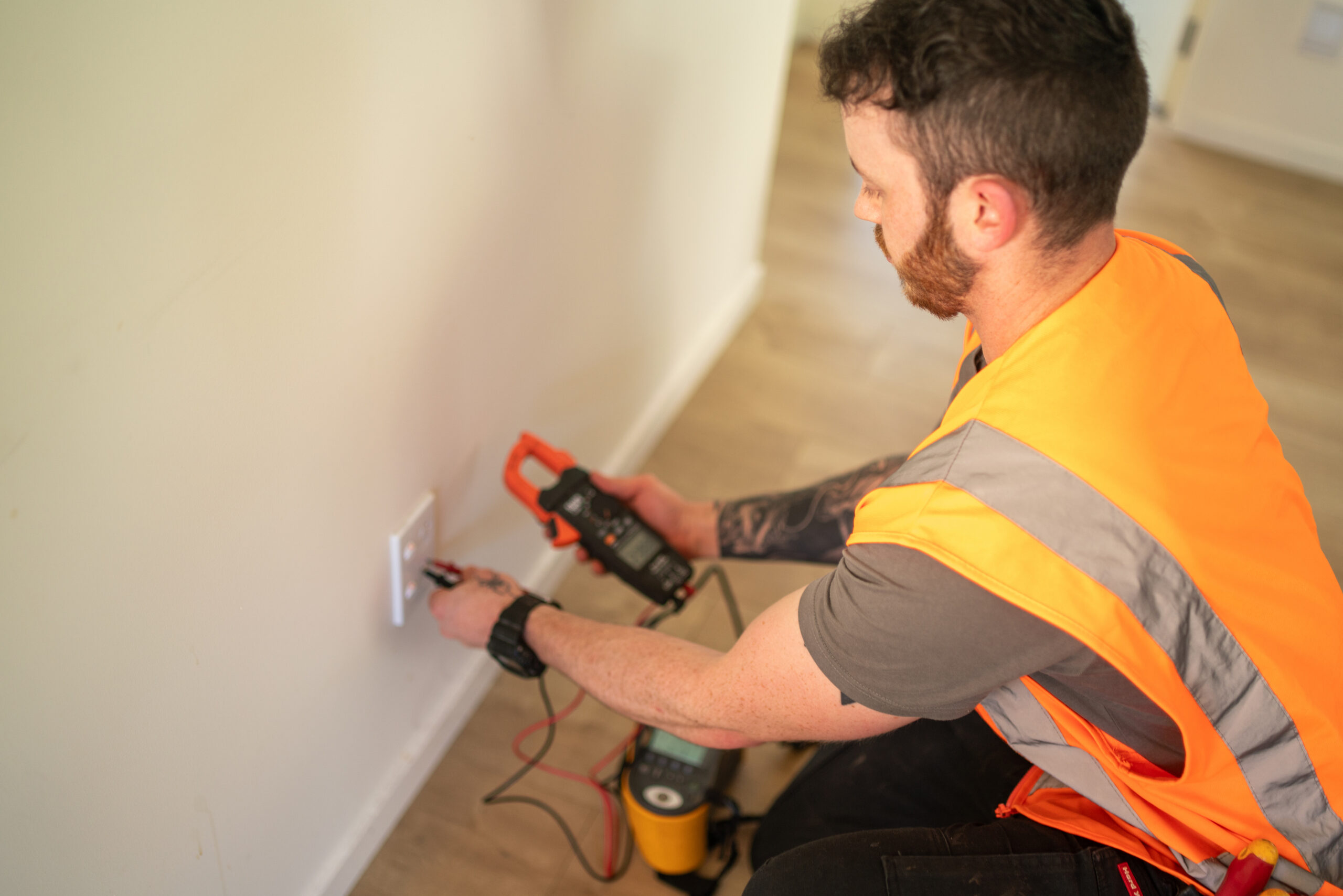
Landlords are responsible for ensuring that the electrical installation in a rented property is safe for tenants to use. This includes arranging periodic inspection and testing, completing required remedial work and responding appropriately when tenants report electrical problems.
For rented homes in England, electrical installations must generally be inspected and tested by a qualified person at least every five years. Landlords must obtain a report following the inspection, retain it and provide copies to tenants and the local authority when required.
These formal checks are only part of electrical safety management. A property can develop a fault between inspections, so landlords should also pay attention to damaged sockets, repeated tripping, overheating, defective appliances and other warning signs reported during the tenancy.
Good electrical safety therefore involves both scheduled inspection and ongoing maintenance.
How often do landlords need an EICR?
For rented properties covered by the regulations in England, the electrical installation must be inspected and tested at intervals of no more than five years, unless the previous report specifies that the next inspection should take place sooner.
The resulting document is commonly known as an Electrical Installation Condition Report, or EICR.
An EICR assesses the condition of the fixed electrical installation rather than simply confirming that sockets and lights currently work.
The inspection can include:
- Consumer units
- Fixed wiring
- Socket circuits
- Lighting circuits
- Earthing arrangements
- Protective devices
- Fixed electrical equipment forming part of the installation
- Signs of deterioration or unsafe alterations
The purpose is to determine whether the installation is safe for continued use and identify areas requiring remedial work or further investigation.
A five-year interval should not be treated as permission to ignore problems between inspections. If a tenant reports a burning smell from a socket six months after an EICR, the landlord should arrange investigation rather than waiting another four and a half years.
Does an EICR have to be carried out exactly every five years?
Five years is generally the maximum interval for properties covered by the electrical safety regulations.
However, the electrician carrying out the inspection may recommend a shorter period.
This might be appropriate because of:
- The condition of the installation
- The age of certain components
- Environmental conditions
- Previous alterations
- The way the property is used
Landlords should therefore look at the date specified on the report rather than automatically adding five years to the previous inspection date.
The report should identify when the next inspection and test are due.
Managing this date in advance can prevent certificates from expiring between tenancies or during a busy period.
What does an EICR actually tell a landlord?
An EICR records observations about the condition of the electrical installation.
Electrical defects are commonly classified using codes that indicate their significance.
These can include:
C1: Danger present
A C1 observation indicates an immediate danger.
Action is required to remove the danger as quickly as possible.
C2: Potentially dangerous
A C2 observation indicates a defect that may become dangerous under certain circumstances.
Remedial work is required.
FI: Further investigation required
An FI observation means that further investigation is necessary because the inspector cannot determine whether a potentially dangerous condition exists without additional work.
C3: Improvement recommended
A C3 observation means that an improvement is recommended but does not, by itself, make an EICR unsatisfactory.
The distinction matters because not every recommendation requires the same response.
Landlords should discuss unclear observations with the electrician rather than treating the report as a simple pass-or-fail document.
What happens if an EICR identifies electrical problems?
Where the report identifies remedial work or further investigation that is required, landlords must arrange for it to be completed within the period specified by the report.
Under the regulations in England, this is generally within 28 days, or sooner if the report specifies a shorter period.
This means a landlord should not simply file away an unsatisfactory EICR and plan to address the problems during the next refurbishment.
Required work might involve:
- Replacing damaged accessories
- Repairing faulty wiring
- Correcting inadequate connections
- Investigating insulation faults
- Improving protective arrangements
- Replacing defective equipment
- Correcting dangerous alterations
Once the work has been completed, the landlord should obtain written confirmation from the qualified person who completed it.
The relevant confirmation must then be supplied as required to the tenant and local authority.
Does every EICR recommendation need immediate work?
Not necessarily.
The response depends on the classification.
A C1, C2 or FI observation normally means that action is needed for the installation to be regarded as satisfactory.
A C3 means that an improvement is recommended, but the observation does not itself make the installation unsatisfactory.
For example, an older installation may not incorporate every feature that would be used in a completely new installation today. That does not automatically make it unsafe.
The electrician should assess the installation against the relevant safety requirements and record observations accordingly.
Landlords should avoid assuming that every difference from a new-build installation means the property requires complete rewiring.
Equally, serious codes should not be downgraded in importance simply because the electrics appear to function normally.
Do landlords need to give the EICR to tenants?
Yes.
The landlord must retain a copy of the electrical safety report and provide it to relevant tenants within the required timescales.
Current Government guidance states that landlords must provide copies of the report to tenants and provide it to the local council if requested.
For an existing tenant, the report should generally be provided within 28 days of the inspection and test.
For a new tenant, a copy should be supplied before they occupy the property.
A prospective tenant who requests a copy may also need to be provided with one within the relevant statutory period.
The landlord should keep the report because it will also be useful when the next inspection takes place.
Good record keeping can include:
- The current EICR
- Previous EICRs
- Electrical installation certificates
- Minor works certificates
- Remedial-work confirmation
- Appliance maintenance records
- Tenant reports of electrical faults
- Smoke and carbon monoxide alarm records
These records create a clearer history of the installation and the work completed.
Can landlords do their own electrical checks?
Landlords can carry out simple visual checks, but formal electrical inspection and testing must be completed by a suitably qualified person.
Electrical Safety First recommends visual inspections annually and/or between tenancies in addition to the formal EICR.
A landlord can look for obvious signs such as:
- Broken sockets
- Cracked switches
- Burn marks
- Missing covers
- Loose accessories
- Damaged flexible cables
- Excessive reliance on extension leads
- Defective light fittings
- Signs of unauthorised alterations
A visual check does not require electrical accessories to be dismantled.
Removing a socket faceplate or consumer-unit cover introduces electrical risks and should be left to a competent electrician.
Visual inspections are useful because tenants may not report every minor defect. An annual inspection or check between tenancies can identify damage before a new occupant moves in.
Who is responsible for electrical repairs during a tenancy?
The landlord is responsible for maintaining the electrical installation provided with the property.
Tenants should report electrical faults rather than attempt repairs themselves.
Electrical Safety First specifically advises tenants not to carry out their own electrical repairs and recommends that problems are reported to the landlord as soon as they appear.
Typical problems that should prompt investigation include:
- A socket that has stopped working
- Repeated circuit tripping
- A burning smell
- Buzzing or crackling
- A loose switch
- Lights flickering repeatedly
- Scorch marks
- Electric shocks
- A damaged consumer unit
- Water entering electrical equipment
The urgency depends on the problem.
A broken light fitting may require a routine repair, while a burning socket or exposed live part needs immediate attention.
Landlords should make it clear how tenants can report urgent electrical faults outside normal office hours.
What if the tenant caused the electrical damage?
Responsibility for the cost of damage and responsibility for making the property safe are two different issues.
If a tenant physically damages a socket, for example, the tenancy agreement and circumstances may determine whether the landlord can recover the repair cost.
However, leaving a dangerous electrical accessory unrepaired because responsibility for the damage is disputed would not be an appropriate approach.
The priority should be to make the installation safe.
Records, photographs and the electrician’s findings can then help establish what happened and whether costs should be recovered from the tenant.
Are landlords responsible for electrical appliances?
A landlord who supplies electrical appliances should take reasonable steps to ensure that they are safe.
Examples may include:
- Fridges
- Freezers
- Washing machines
- Tumble dryers
- Microwaves
- Kettles
- Lamps
- Vacuum cleaners
The responsibilities applying to supplied equipment can depend on the type of tenancy and housing sector.
Government guidance introduced in 2025 also extended electrical safety requirements across private and social rented sectors, including requirements relating to electrical equipment supplied by social landlords.
For private landlords, routine appliance safety management remains good practice even where a specific portable appliance testing interval is not prescribed for an ordinary tenancy.
Electrical Safety First recommends checking equipment for damage and ensuring that any landlord-supplied appliance is safe to use.
Visual checks may identify:
- Frayed cables
- Cracked plugs
- Burn marks
- Loose connections
- Damaged appliance casings
- Missing manufacturer information
Where there is uncertainty, appropriate electrical testing can be arranged.
Do landlords have to carry out PAT testing?
There is no universal rule requiring every ordinary private landlord in England to arrange annual PAT testing for every portable appliance in every rented property.
However, landlords remain responsible for ensuring that equipment they provide is safe.
The requirements can differ for particular accommodation types, licensed HMOs or other regulated settings.
PAT testing may therefore form part of a sensible maintenance programme, particularly where a furnished property contains several landlord-owned appliances.
The frequency should be based on factors such as:
- The type of appliance
- How frequently it is used
- The environment
- Previous test results
- Manufacturer recommendations
- Visible condition
Landlords should check whether additional licence conditions or local requirements apply to their particular property.
What smoke alarm responsibilities do landlords have?
Smoke alarms are not part of an EICR in the same way as the fixed wiring, but they are an important part of a landlord’s wider safety responsibilities.
In England, landlords must provide at least one smoke alarm on each storey containing a room used as living accommodation.
Landlords must also ensure that alarms are working at the start of a new tenancy.
If a tenant reports that a required smoke or carbon monoxide alarm is faulty, the landlord must repair or replace it once the fault has been identified.
Where alarms are mains-powered, electrical work may be required to replace the alarm head, base or supply.
Landlords should also keep an eye on alarm expiry dates because smoke alarm sensors have a finite service life even when the unit remains powered.
What about carbon monoxide alarms?
In England, landlords must provide a carbon monoxide alarm in any room used as living accommodation that contains a fixed combustion appliance, other than a gas cooker.
This can apply to appliances such as:
- Gas boilers
- Wood-burning stoves
- Open fires
- Oil-fired appliances
- Other fixed combustion equipment
The alarm should be installed in an appropriate location in accordance with the manufacturer’s instructions.
Like smoke alarms, carbon monoxide alarms should be repaired or replaced when a landlord is informed that a required unit is faulty.
These alarms perform different functions. A carbon monoxide alarm does not replace a smoke alarm, and a smoke alarm does not detect carbon monoxide.
What should landlords check between tenancies?
The changeover between tenants is a useful opportunity to inspect areas that may have been difficult to access while the property was occupied.
A sensible electrical visual check can include:
- Sockets and switches
- Light fittings
- Consumer-unit labels
- Smoke alarms
- Carbon monoxide alarms
- Landlord-supplied appliances
- Outdoor sockets
- Extension leads supplied with the property
- Visible cables
- Bathroom electrical accessories
Check for broken fittings, scorch marks, damage caused by furniture and signs that tenants may have made alterations.
You may also discover that the way the property is being used has changed.
For example, a bedroom that has become a home office may rely heavily on extension leads because there are not enough sockets. While this does not automatically require electrical alterations, installing additional sockets may provide a safer and more practical arrangement for future tenants.
The landlord should also confirm that required alarms work at the beginning of each new tenancy.
What if tenants install their own electrical equipment?
Tenants routinely connect their own televisions, computers, kitchen appliances and chargers. That is normal use of a rented home.
Problems can arise when occupants make changes to the fixed electrical installation without permission.
Examples include:
- Replacing light fittings
- Adding sockets
- Changing switches
- Installing outdoor wiring
- Altering fixed heaters
- Installing an EV charger
- Running permanent cables between rooms
Tenancy agreements can make clear that alterations require written permission.
If unauthorised work is discovered, it should be inspected by a competent electrician rather than assumed to be safe because it appears to function.
Landlords should also discourage unsafe use of extension leads and adaptors, particularly where tenants connect several high-powered appliances to one outlet.
What are the penalties for failing to meet electrical safety duties?
Failure to comply with the electrical safety regulations can lead to enforcement by the local authority.
For breaches of the electrical safety requirements, local authorities can impose financial penalties of up to £30,000 per offence.
Where required remedial work is not completed, the council may also arrange work itself in certain circumstances and recover the costs.
The financial penalty is important, but the greater concern is tenant safety.
Electrical defects can result in:
- Electric shock
- Burns
- Fire
- Loss of power
- Damage to appliances
- Unsafe exposed parts
Maintaining inspection records and responding quickly to problems helps demonstrate that electrical safety is being actively managed rather than treated as a paperwork exercise.
What should landlords do when buying a rental property?
A landlord purchasing a property should not assume that an existing electrical certificate remains suitable without checking it.
Before letting the property:
- Find the latest EICR.
- Check the inspection date.
- Check the recommended next-inspection date.
- Confirm whether the report was satisfactory.
- Verify that required remedial work was completed.
- Retain any certificates associated with later electrical work.
- Check the condition of supplied appliances.
- Test smoke and carbon monoxide alarms.
- Arrange a new inspection if the existing documentation is inadequate or expired.
An EICR belonging to a previous owner may still contain useful information, but the landlord should make sure that nothing significant has changed since it was completed.
Renovation work, a new kitchen, an extension or undocumented electrical alterations could affect the installation.
Frequently Asked Questions
Does every landlord need an EICR every five years?
Rented properties covered by the electrical safety regulations in England need periodic inspection and testing at least every five years, or sooner if the previous report specifies a shorter interval.
Can a tenant move in before receiving the EICR?
The landlord should provide the electrical safety report to a new tenant before they occupy the property.
Does a C3 code make an EICR unsatisfactory?
No. C3 means improvement is recommended. C1, C2 or FI observations are generally the classifications that cause the overall assessment to be unsatisfactory.
How quickly must a landlord complete electrical remedial work?
Required remedial or investigative work must generally be completed within 28 days, unless the EICR specifies a shorter period.
Is PAT testing legally required every year?
There is no blanket requirement for annual PAT testing of every appliance in every ordinary private rental property in England. However, landlord-supplied electrical equipment should be safe, and additional requirements may apply to particular properties.
Who pays for an EICR?
The landlord is responsible for arranging the required inspection and meeting its cost. It forms part of the landlord’s responsibility for maintaining a safe electrical installation.
Treat electrical safety as ongoing property maintenance
A valid EICR is a central part of a landlord’s electrical safety responsibilities, but good management does not end when the certificate is filed away.
Landlords need to arrange inspection and testing at the required intervals, complete necessary remedial work, provide documentation to tenants and respond when electrical problems are reported.
Between formal inspections, visual checks can help identify damaged sockets, defective appliances, failed alarms or unsafe tenant alterations before they develop into more serious problems.
Clear records also make managing the property easier. Keeping EICRs, electrical certificates, remedial-work documentation and alarm records together provides a useful history for future electricians, tenants and property managers.
Requirements can differ elsewhere in the UK and additional rules may apply to HMOs, licensed properties and specific types of rented accommodation. Landlords should therefore check the rules applying to the individual property rather than relying on assumptions from another tenancy.
For help with landlord electrical testing, EICRs, remedial electrical work or investigating faults in a rented property, contact Big Fish Electrician.
Phone: 07789 214528
Email: mike.thomas@bigfishea.co.uk
Find out more: Big Fish Electrician