Many UK homes can have a dedicated electric vehicle charger installed, but not every property is suitable for a straightforward standard installation.
The main considerations are whether the vehicle can be parked safely near the property, whether a suitable cable route is available and whether the electrical supply can support the additional demand. The installer must also assess the existing consumer unit, earthing arrangements and protective devices.
Homes with private driveways and accessible consumer units are often relatively simple to assess. Flats, rented homes, properties with shared parking and houses without off-street parking can be more complicated, but they are not necessarily excluded.
Some installations require permission from a landlord, freeholder or managing agent. Others may need work by the local Distribution Network Operator, commonly called the DNO, before the charger can be connected.
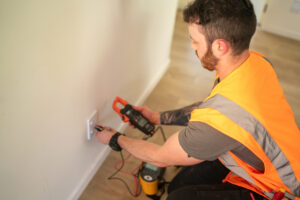
The safest way to determine whether a property is suitable is through a site survey by an electrician who is competent and appropriately trained in EV charge point installation. Electrical Safety First states that a home charging point should be fitted by a registered, competent electrician who is qualified to install EV charging equipment.
Do you need off-street parking for a home EV charger?
Private off-street parking usually makes a home charger easier to install and use.
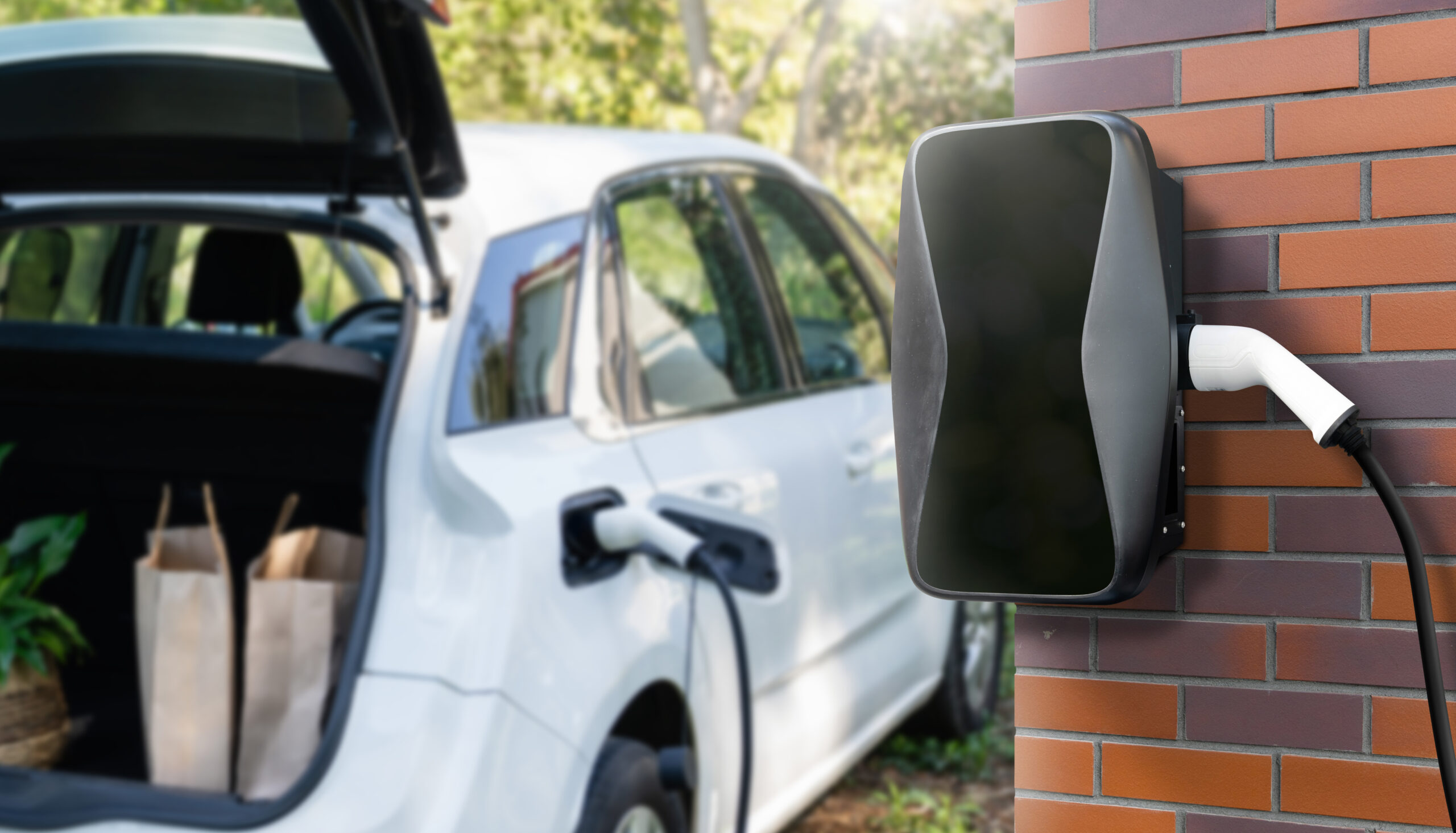
A vehicle parked on a driveway, in a garage or in a designated private space can often be connected without running a cable across a public pavement. The charger may be fitted to an external wall, inside a garage or on a suitable mounting post close to the parking position.
The installer will still need to check that:
- The charging cable can reach the vehicle safely.
- The cable will not create a trip hazard.
- The charger can be protected from accidental impact.
- The equipment is appropriate for its outdoor location.
- The cable route back to the electrical supply is practical.
- The parking space belongs to or is legally available to the customer.
Off-street parking does not need to be directly beside the consumer unit. A longer cable route may be possible, although it can increase the complexity and cost of the installation.
The installer may need to route cable around the outside of the house, beneath floors, through a garage or underground. The chosen route must protect the cable from weather, impact and other foreseeable damage.
Can you install an EV charger without a driveway?
A lack of a driveway makes home charging more difficult, but it does not always make it impossible.
The major issue is that an ordinary charging cable should not simply be laid across a public pavement. It could create a trip hazard, obstruct wheelchair users or pushchair access and expose the cable to damage.
A homeowner also cannot assume that they have the right to reserve the section of road outside their property. Even if a charging cable could physically reach the vehicle, the parking space may not be available every evening.
Some local authorities support approved cross-pavement charging channels or gullies. These are designed to contain the cable below or within the pavement surface rather than leaving it trailing across the walkway.
The Government currently offers an electric vehicle charge point grant for eligible households with on-street parking that are installing an approved cross-pavement solution. The scheme can provide up to £500, but applicants must satisfy the published eligibility requirements.
Any work affecting the pavement or highway is likely to require permission from the relevant authority. The availability of suitable schemes also differs between areas.
Where a safe and approved home installation is not practical, the driver may need to use workplace, destination or public charging instead.
Can an older house support an EV charger?
An older house can often have an EV charger, but its electrical installation needs to be assessed first.
The age of the property does not determine suitability on its own. An older home may have been rewired and fitted with modern protective equipment, while a newer property may have defects or limited spare capacity.
The electrician will consider:
- The condition of the consumer unit
- The type and rating of the main supply
- Earthing and bonding
- Existing circuit demand
- Available space for protective devices
- The condition of existing wiring
- The proposed charging rate
- Other high-demand equipment in the property
An EV charger normally requires a dedicated electrical circuit rather than being added casually to a general socket circuit.
Electric vehicle charging involves a substantial load that may continue for several hours. The circuit therefore needs to be designed specifically for the equipment and installation conditions.
The IET’s current Code of Practice covers the planning, physical requirements and electrical requirements involved in EV charging installations. It is aligned with the relevant edition of BS 7671 and associated network guidance.
If the existing consumer unit is unsuitable, it may need alteration, additional protective equipment or replacement before the charge point can be installed.
However, a consumer-unit upgrade does not automatically mean that the whole house needs rewiring. The decision should be based on inspection and testing.
What happens if the electrical supply is not powerful enough?
An EV charger adds to the total amount of electricity that a property may use at one time.
The installer must consider the expected demand from existing equipment, such as:
- Electric showers
- Immersion heaters
- Electric heating
- Ovens and hobs
- Heat pumps
- Hot tubs
- Solar and battery equipment
- Other EV chargers
If the total potential demand is too high, the property may require a supply upgrade or a method of controlling the load.
The DNO is responsible for the local electricity distribution network. Depending on the proposed installation and available supply capacity, the charger may be installed and then notified to the DNO, or approval may be required before work proceeds.
UK Power Networks explains that some EV chargers can be connected and notified after installation, while other properties need an electricity supply upgrade first because the existing supply cannot support the additional load.
The exact process is normally handled or coordinated by the installer. Energy Networks Association guidance also recommends that a qualified installer assess the location and electrical suitability before connection.
Can load management avoid a supply upgrade?
In some homes, load management can help prevent the charger and other equipment from exceeding the available supply.
A charger with dynamic load management monitors the electricity being used by the property. It can reduce the charging rate temporarily when demand elsewhere in the house is high.
For example, the charger may lower its output while an electric shower or oven is operating, then increase the charging rate when the household demand falls.
This can make use of the available capacity more effectively, although it does not solve every supply limitation.
The electrician must confirm that the selected charger, monitoring equipment and overall installation are suitable.
How fast can a home EV charger be?
The charging speed available at home depends on the charger, vehicle, electrical supply and network arrangements.
A commonly used domestic wall charger provides a faster and more controlled charging method than relying on a standard household socket. Energy Networks Association guidance notes that a dedicated charge point can offer substantially faster charging than an ordinary three-pin connection.
However, fitting the highest-rated charger available does not necessarily mean the vehicle will charge at that rate.
Charging speed can be limited by:
- The vehicle’s onboard charger
- The property’s electricity supply
- Load-management settings
- The charging cable
- The vehicle battery temperature
- The battery’s state of charge
- Scheduled charging settings
The charger should be selected according to the property and vehicle rather than on headline power alone.
A slightly slower charger may still refill the vehicle comfortably overnight, particularly when the driver does not arrive home with an empty battery every day.
Can you charge an EV from an ordinary plug socket?
Some electric vehicles are supplied with or can use a lead designed for connection to a suitable domestic socket. This is generally a slower charging method.
It should not be treated as a permanent substitute for assessing whether the socket and circuit are suitable for repeated EV charging.
Electrical Safety First describes a dedicated wallbox installed by a qualified professional as the safest and most convenient method of charging an electric vehicle at home.
EV charging can place a continuous load on a socket for many hours. An old, damaged or poorly connected socket may overheat under conditions that do not occur during shorter everyday use.
Never use:
- A damaged socket
- A standard extension lead
- A multi-socket adaptor
- A cable running through water
- A plug or lead that becomes hot
- Equipment not approved for vehicle charging
Electrical Safety First also recommends checking charging cables regularly and stopping use where damage is found.
A dedicated charge point offers appropriate control and protective features and is usually positioned specifically for safe vehicle charging.
Do renters need permission to install an EV charger?
A tenant should obtain the property owner’s written permission before arranging fixed electrical work.
An EV charger becomes part of the property and may require:
- Drilling through walls
- Installing new electrical cabling
- Altering the consumer unit
- Fixing equipment to an external wall
- Excavating a cable route
- Installing a post
- Changing a communal area
The landlord may want to approve the proposed installer, charger position and ownership arrangements.
The parties should also agree what happens at the end of the tenancy. The charger might remain at the property, be transferred to the landlord or be removed and the property made good.
Eligible renters may currently qualify for a Government charge point grant of up to £500, provided they satisfy the scheme conditions, including the relevant parking requirements.
The grant does not remove the need for the landlord’s permission or make an unsuitable installation acceptable.
Can a flat have an EV charger?
Some flat owners and residents can have an EV charger installed, especially where the property has allocated parking.
The practical and legal arrangements can be more complicated than they are for a detached or terraced house.
Questions may include:
- Who owns the parking space?
- Who owns the wall or ground where the charger will be mounted?
- Does the cable cross a communal area?
- Which electricity meter will supply the charger?
- Who pays for the electricity?
- Is the communal supply capable of supporting charging?
- Is freeholder or managing-agent permission required?
- How will future chargers for other residents be managed?
UK Power Networks advises that permission from the building owner is important for installations at multi-occupied buildings such as blocks of flats.
Where several residents may eventually want chargers, the freeholder or management company may benefit from planning shared infrastructure rather than allowing unrelated individual installations.
A coordinated design can consider network capacity, billing, cable routes, fire safety and the future addition of more charging points.
Eligible flat owners may also qualify for current Government grant support, subject to the published criteria.
Do you need planning permission?
Many domestic charge point installations can be completed without a separate planning application, but permission requirements depend on the property, position and nature of the work.
Extra considerations may apply where:
- The property is listed.
- The charger affects a protected building.
- The installation is within a conservation area.
- A separate mounting structure is proposed.
- Work affects the highway or pavement.
- The parking area is communal.
- The property is leasehold.
- The installation is unusually prominent.
Planning permission and property-owner consent are separate issues. An installation may not need planning permission but may still require approval from a landlord, freeholder or management company.
The installer should not be expected to resolve every property-law question. The homeowner or tenant should confirm the necessary permissions before work begins.
What does an electrician check during an EV charger survey?
A survey allows the installer to determine whether the charger can be fitted safely and what additional work may be needed.
The assessment may cover:
The electricity supply
The installer checks the main supply details and considers the property’s existing electrical demand.
They may need information from the DNO or electricity meter arrangements before confirming the design.
The consumer unit
The electrician assesses whether the consumer unit has suitable capacity and whether the required protective equipment can be provided.
Signs of damage, overheating or outdated equipment may need further investigation.
Earthing and safety protection
EV charging has specific electrical safety considerations because the vehicle is a large conductive object used outdoors.
The installer must design the earthing and protective arrangements to suit the property, charger and electricity supply. The IET publishes detailed requirements and guidance covering RCD protection and other EV charging safety measures.
The cable route
The cable must travel safely from the electrical supply to the charge point.
The installer considers:
- Wall construction
- Floor access
- Outdoor routes
- Underground sections
- Existing services
- Cable protection
- The length of the route
- Decoration and making good
The charging position
The charger should be accessible without leaving the vehicle cable stretched, coiled dangerously or crossing a walkway.
The likely position of the vehicle’s charging port also matters. Different vehicles place the port at the front, rear or side.
Internet or mobile connectivity
Smart chargers may need access to Wi-Fi, mobile data or another communication method.
A weak signal at the parking location could affect app features, software updates or scheduled charging. Connectivity should be checked before the final charger position is chosen.
Will installing an EV charger cause much disruption?
The level of disruption depends mainly on the cable route and the condition of the existing electrical installation.
A charger on the outside wall directly behind the consumer unit may require relatively limited work. A charger at the end of a detached garage or distant parking area could need a much longer route and excavation.
Possible work includes:
- Drilling through an external wall
- Installing visible cable containment
- Lifting floorboards
- Routing cable through a loft or garage
- Excavating soft ground
- Cutting a channel across a hard surface
- Altering the consumer unit
- Installing a separate enclosure
- Completing supply upgrade work
The survey should establish these requirements before installation begins.
Homeowners should ask whether quotations include drilling, groundwork, decorative repairs, DNO-related work and commissioning so that the scope is clear.
Are all home EV chargers smart chargers?
Current UK regulations apply smart functionality requirements to many private charge points sold for domestic and workplace use.
Smart charging allows the equipment to respond to schedules, electricity tariffs or periods of network demand. It may enable charging to begin automatically during selected off-peak periods rather than immediately when the vehicle is connected.
The charger still needs to be suitable for the vehicle and electrical installation.
Useful features may include:
- Scheduled charging
- App monitoring
- Energy-use reports
- Solar compatibility
- Dynamic load management
- Tariff integration
- User access controls
- Over-the-air updates
Features differ substantially between products. Homeowners should consider which functions they are genuinely likely to use and whether the manufacturer provides continuing software support.
What could prevent an EV charger from being installed?
A proposed installation may need to be changed, delayed or declined where:
- There is no safe parking arrangement.
- The customer does not have permission to use the parking space.
- A cable would need to cross a public pavement without an approved solution.
- The electrical installation contains serious defects.
- The supply requires a DNO upgrade.
- The proposed cable route is unsafe or inaccessible.
- The charger cannot be protected against damage.
- Required landlord or freeholder permission has not been obtained.
- The selected charger is incompatible with the property.
- The customer expects unsafe use of an extension lead.
In many cases, the problem can be resolved through a different charger location, remedial electrical work, load management or an upgraded supply.
The purpose of the survey is to identify these issues before equipment is purchased or installation work begins.
Frequently Asked Questions
Can I install an EV charger before buying an electric car?
Yes. However, check the connector type, charging capabilities and likely vehicle requirements before selecting equipment. Some homeowners install a charger while preparing for a future vehicle purchase.
Does an EV charger need its own circuit?
A dedicated circuit is generally used for fixed EV charging equipment. The installer must design the circuit and protective arrangements for the charger and property.
Can I have two EV chargers at home?
Potentially, but the installer must assess the supply capacity and total demand. Load management may be needed to prevent both vehicles and household equipment from exceeding the available supply.
Can solar panels power an EV charger?
Some chargers can coordinate with solar generation, allowing surplus electricity to contribute to vehicle charging. Actual performance depends on the solar output, charger, vehicle, household demand and system design.
Will I need a new consumer unit?
Not always. The existing consumer unit may be suitable or may be adaptable. Replacement or additional equipment may be required if it lacks capacity, suitable protection or is in poor condition.
Who tells the DNO about the charger?
The installer normally handles the relevant DNO notification or application process. Whether approval is required before installation depends on the charger, supply and local network circumstances.
Most homes need an assessment, not an assumption
A wide range of UK properties can support home EV charging, including many older houses, rented homes and flats.
However, suitability depends on more than finding an outdoor wall and purchasing a charger. The property needs a safe parking arrangement, an appropriate cable route and an electrical supply capable of supporting the additional demand.
Some homes can receive a charger with relatively little alteration. Others require consumer-unit work, load management, landlord permission, a supply upgrade or an approved cross-pavement solution.
A professional survey provides the information needed to select the right charger and plan the installation accurately. It also prevents homeowners from relying on ordinary extension leads or unsuitable sockets for repeated vehicle charging.
For advice about EV charger installation and assessing whether your Hampshire property is suitable, contact Big Fish Electrician.
Phone: 07789 214528
Email: mike.thomas@bigfishea.co.uk
Find out more: Big Fish Electrician