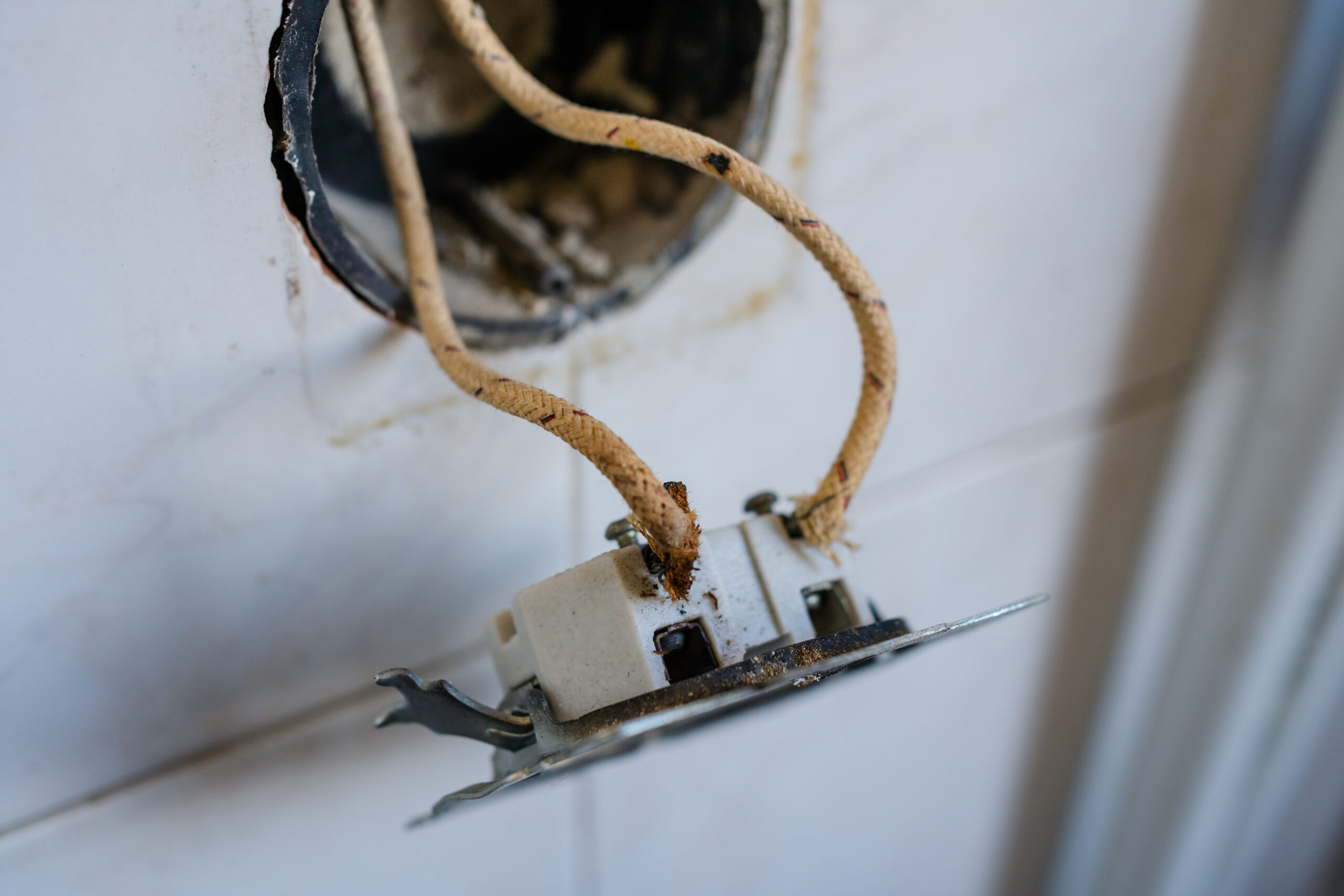
Common signs of outdated wiring include old-style sockets and switches, a dated fuse box, frequent electrical tripping, flickering lights, damaged cable insulation and a shortage of sockets throughout the property.
However, age alone does not prove that an electrical installation is unsafe. Some older wiring may remain serviceable if it was installed correctly, has been maintained and has not been damaged. Equally, relatively recent wiring can still be unsafe if it was poorly installed or altered incorrectly.
The only reliable way to understand the condition of a property’s wiring is through professional inspection and testing.
Visible clues can still be useful. They may indicate that the installation was designed for a very different level of electrical demand or that parts of it have deteriorated over time.
Homeowners should pay particular attention to warning signs such as burning smells, scorch marks, buzzing sounds or repeated protective-device operation. These symptoms may indicate an active electrical fault rather than simply an old installation.
How can you tell how old your home’s wiring is?
It is not always possible to determine the exact age of an electrical installation by looking at one socket or switch.
Properties are often altered gradually. A house may contain wiring from several different periods because rooms have been renovated, extensions have been added or individual circuits have been replaced.
For example, a modern consumer unit does not necessarily mean that all the wiring behind the walls is equally recent. A new unit may have been connected to older circuits that remained in place.
Likewise, modern-looking sockets may have been fitted to old cabling.
Useful sources of information include:
- Electrical installation certificates
- Previous Electrical Installation Condition Reports
- Building-control records
- Invoices from earlier electrical work
- Labels on the consumer unit
- Information from previous owners
Where records are unavailable, an electrician can inspect accessible cables, accessories and the consumer unit to estimate the likely age and type of installation.
The focus should be on condition and safety rather than establishing an exact installation date.
Does an old fuse box mean the wiring is outdated?
An older fuse box is one of the most noticeable signs that an electrical installation has not been comprehensively upgraded for some time.
Traditional fuse boxes may contain rewireable fuses or cartridge fuses rather than modern circuit breakers. These devices can still disconnect a circuit during certain faults, but they may not provide the range of protection found in a modern consumer unit.
Modern installations commonly use circuit breakers, residual current devices and combined protective devices. These can provide protection against overcurrent and certain types of earth-leakage fault.
A dated fuse box does not automatically prove that the property needs a complete rewire. It does, however, justify further assessment.
An electrician will need to consider:
- The type and condition of the wiring
- Earthing and bonding arrangements
- Whether suitable RCD protection is present
- The condition of the fuse box itself
- Previous additions and alterations
- Whether circuits can be clearly identified
- Signs of overheating or damage
Replacing a fuse box without assessing the connected circuits may leave underlying wiring problems unresolved. The installation should be tested before deciding whether a consumer-unit replacement, circuit repair or wider upgrade is appropriate.
What types of old wiring might be found in a property?
Different cable types have been used in UK properties over the decades. Some are more likely to require replacement than others, particularly where insulation has deteriorated.
Older installations may contain:
Rubber-insulated cables
Rubber insulation can become brittle, crack and fall away as it ages. This may expose conductors or reduce the cable’s ability to contain electricity safely.
The condition may be particularly poor near light fittings or other warm areas.
Rubber-insulated wiring should be professionally assessed. Deterioration is not always visible because much of the cable may be concealed.
Lead-sheathed cables
Some older properties contain cables with a lead outer covering.
These installations may still be encountered during renovation work. Their condition, earthing arrangements and suitability need careful assessment.
They should not be disturbed unnecessarily by anyone who is not competent to inspect them.
Fabric-covered or braided cables
Very old wiring may have a fabric or braided outer appearance.
Age, heat and movement can cause this material to deteriorate. It may also indicate that the electrical installation has been in place for many decades.
Older PVC-insulated wiring
PVC cable can last for a considerable period, but it is not immune to damage.
Heat, overloading, physical impact, chemical exposure and poor connections can affect its condition. Some older PVC cables may also show deterioration near accessories or lighting points.
The presence of PVC insulation does not prove that a circuit meets modern safety expectations. Testing is still required to assess its condition.
What visible signs suggest the wiring is outdated?
Most fixed wiring is hidden, but visible accessories and electrical behaviour can provide useful clues.
Old or inconsistent sockets and switches
A mixture of socket and switch styles can indicate that alterations have been made at different times.
This is not necessarily unsafe, but it may suggest that the installation has developed gradually rather than being comprehensively upgraded.
Older accessories may appear:
- Discoloured
- Brittle
- Cracked
- Loose
- Shallow or unusually shaped
- Painted over
- Worn around switches
Some older sockets may not include switches, while others may lack features now commonly expected.
The condition matters more than appearance alone. A decorative old-style socket may be relatively new, while a modern-looking faceplate may conceal an older back box or cable.
Too few sockets
Older homes were built when households owned far fewer electrical appliances.
A room with only one or two sockets may not be unsafe, but it can encourage heavy reliance on extension leads and adaptors.
Common areas affected include:
- Living rooms with televisions and entertainment equipment
- Bedrooms with chargers and bedside lamps
- Home offices with computers and monitors
- Kitchens with multiple countertop appliances
- Garages and workshops
A shortage of sockets can indicate that the installation no longer matches the way the property is used.
Adding sockets may improve practicality, but the existing circuit should first be assessed to confirm that it can safely support further outlets and expected demand.
Surface-mounted alterations
Surface-mounted wiring is not automatically outdated or unsafe. It can be a legitimate installation method when suitable materials are used and cables are correctly protected.
Concerns arise when additions appear improvised, poorly supported or inconsistent.
Watch for:
- Loose cables
- Broken trunking
- Exposed connections
- Cables routed across doorways
- Junction boxes without covers
- Different cable types joined together
- Accessories that move when plugs are inserted
These signs may indicate previous work that requires inspection.
Missing or unclear circuit labels
The consumer unit should allow circuits to be identified clearly.
Handwritten labels that no longer match the property, crossed-out descriptions or completely unmarked protective devices can indicate numerous alterations over time.
Poor labelling does not necessarily make the installation dangerous, but it makes safe isolation more difficult and may suggest that records have not been maintained.
Which warning signs need urgent attention?
Some symptoms should be treated as possible active faults rather than ordinary signs of age.
Burning smells
A burning or hot-plastic smell near a socket, switch, light fitting or consumer unit requires immediate attention.
Switch off the affected circuit if this can be done safely and do not continue using the equipment.
A burning smell may indicate:
- A loose connection
- Overheating
- Damaged insulation
- A failing accessory
- Overloaded equipment
- Arcing
Do not remove covers or touch equipment that appears hot or damaged.
Scorch marks and discolouration
Brown marks, blackening, melted plastic or bubbling around electrical accessories can indicate heat damage.
The accessory should not be used until it has been inspected.
Simply replacing the visible faceplate may not correct the cause. The cable and connections behind it may also be damaged.
Buzzing or crackling sounds
Sockets and switches should not normally produce persistent buzzing or crackling.
These sounds may be caused by loose connections, damaged contacts or electrical arcing.
Stop using the affected accessory and arrange professional investigation.
Electric shocks or tingling sensations
Any electric shock from an appliance, tap, radiator, switch or other conductive surface is a serious warning sign.
Disconnect the relevant equipment only if this can be done safely and seek professional advice.
A tingling sensation can indicate a fault involving earthing, bonding, an appliance or the fixed installation.
Smoke or sparks
Smoke, repeated sparking or visible flames require immediate action.
Turn off the electrical supply only when safe to do so, leave the area if necessary and contact the emergency services where there is a fire or immediate danger.
Never use water on an electrical fire.
Why do outdated electrics trip more often?
Frequent tripping can occur for several reasons and does not always mean that the wiring is old.
A protective device may operate because of:
- A faulty appliance
- Circuit overloading
- Damaged insulation
- Moisture
- A loose connection
- A short circuit
- Excessive earth leakage
- A defective socket or fitting
Older installations may be more likely to contain deteriorated components or circuits that were not designed for current household demand.
For example, a kitchen circuit originally intended for a small number of appliances may now supply a kettle, toaster, microwave, dishwasher, washing machine and other equipment.
Repeatedly resetting a circuit breaker, RCD or RCBO does not solve the problem. The device is disconnecting the supply because it has detected conditions that may be unsafe.
If tripping becomes more frequent, occurs without an obvious cause or continues with appliances unplugged, the circuit needs professional fault finding.
Are flickering lights a sign of old wiring?
Flickering lights can be caused by something as simple as a loose lamp, an incompatible dimmer or a failing bulb.
However, widespread or repeated flickering can also indicate a problem with a circuit or connection.
Pay attention to whether the flicker:
- Affects one lamp or several rooms
- Occurs when a particular appliance starts
- Happens during windy or wet weather
- Is accompanied by buzzing
- Is becoming more frequent
- Causes lights to become unusually bright or dim
One flickering fitting may have a local fault. Several lights changing brightness together may indicate a wider issue requiring prompt investigation.
Do not assume that changing the bulb will solve the problem if the symptoms continue.
Can old wiring still be safe?
Yes, some older wiring can remain safe and serviceable.
Electrical installations do not become unsafe automatically on a particular birthday. Their condition depends on the original installation quality, materials, use, environmental conditions, maintenance and any alterations made since.
An older installation may remain suitable if:
- Cable insulation is in good condition
- Connections are secure
- Earthing and bonding are adequate
- Protective devices operate correctly
- Circuits are not overloaded
- Alterations have been completed properly
- Test results are satisfactory
However, an installation can still be outdated in practical terms even when it is not immediately dangerous.
It may lack enough sockets, suitable protection or capacity for modern equipment. Improvements may be recommended to reduce risk and make it better suited to current use.
Testing helps separate issues that require urgent correction from recommended upgrades and longer-term improvements.
Does outdated wiring always mean a full rewire?
No. A complete rewire is not the only possible outcome.
Depending on the inspection and test results, the electrician may recommend:
- Replacing damaged accessories
- Repairing a section of cable
- Upgrading the consumer unit
- Improving earthing or bonding
- Adding RCD protection
- Replacing one affected circuit
- Removing unsafe alterations
- Installing additional sockets
- Improving circuit labelling
A full rewire may be appropriate when cables have deteriorated widely, the installation contains serious defects or the existing design cannot be upgraded safely and practically.
The decision should be based on evidence.
Homeowners should be cautious of conclusions reached solely from photographs, the age of the property or the appearance of the fuse box. A proper assessment requires inspection and electrical testing.
When should outdated wiring be professionally tested?
Consider arranging electrical testing when:
- You are buying an older property.
- The age or history of the wiring is unknown.
- The installation has not been inspected for many years.
- You are planning major renovation work.
- Several rooms rely heavily on extension leads.
- Protective devices trip regularly.
- Sockets, switches or cables show signs of damage.
- The property has suffered flooding or a significant leak.
- You notice burning smells, buzzing or discolouration.
- Previous electrical alterations appear poorly completed.
- You are installing equipment with substantial electrical demand.
Testing can identify issues that are not visible during an ordinary property survey.
It also provides a clearer basis for budgeting. Instead of assuming the entire property needs rewiring, you can understand which circuits are satisfactory, which require improvement and which may need replacement.
What happens during an inspection?
An electrician will normally begin by discussing the property and any known concerns.
A visual assessment may include:
- The consumer unit
- Accessible wiring
- Sockets and switches
- Light fittings
- Signs of overheating
- Earthing and bonding
- Previous alterations
- Outdoor electrical equipment
Instrument testing can then provide information about the circuits and protective arrangements.
Testing may require the supply to be disconnected for periods while circuits are isolated. Sensitive equipment should be switched off properly beforehand.
The electrician may record observations according to their severity and explain whether work is urgent, recommended or requires further investigation.
The purpose is not simply to pass or fail the property. It is to identify risks and provide a practical plan for addressing them.
How should you prepare for electrical testing?
Before the visit:
- Make a note of any recurring electrical problems.
- Identify sockets or switches that become warm.
- Record which circuits trip and when.
- Locate previous electrical certificates if available.
- Provide access to the consumer unit.
- Move furniture where sockets need inspection.
- Save work and safely shut down computers.
- Tell the electrician about hidden outdoor supplies or outbuildings.
Do not remove covers or expose wiring yourself.
Clear information can help the electrician distinguish between an installation-wide problem and a fault associated with one appliance or circuit.
Frequently Asked Questions
How often should home wiring be replaced?
There is no single replacement age that applies to every property. Wiring should be assessed according to its type, condition, test results and the way the installation is used.
Does a plastic consumer unit mean the electrics are unsafe?
Not automatically. The material and age of the consumer unit are only part of the assessment. Its condition, protective devices, installation method and connected circuits also need to be considered.
Are two-pin sockets a sign of outdated wiring?
Old or unusual socket types may indicate that part of the installation is dated. They should be assessed rather than adapted for continued use without professional advice.
Can modern sockets be connected to old wiring?
They can be, which is why a modern-looking socket does not confirm that the wiring behind it is recent. Electrical testing is needed to assess the circuit itself.
Is frequent bulb failure linked to old wiring?
Repeated bulb failure can have several causes, including poor-quality lamps, overheating fittings, loose connections or voltage issues. Persistent problems should be investigated.
Should I rewire before renovating?
It is sensible to assess the electrical installation before major redecoration or structural work. Where rewiring is needed, completing it before plastering, flooring and decoration can reduce duplicated disruption.
Look beyond the age of the property
Outdated wiring does not always announce itself through one obvious symptom.
A dated fuse box, limited sockets, old accessories and inconsistent alterations may suggest that the installation has not been comprehensively upgraded. More serious signs such as burning smells, scorch marks, shocks, buzzing or repeated tripping require prompt attention.
The age of a house alone cannot determine whether its wiring is safe. Some older installations remain serviceable, while newer wiring may contain faults caused by poor workmanship or damage.
Professional inspection and testing provide the evidence needed to make an informed decision. The outcome may be a minor repair, targeted circuit replacement, consumer-unit upgrade or complete rewire, depending on what is actually found.
For advice about older wiring, electrical testing or planning an upgrade, contact Big Fish Electrician.
Phone: 07789 214528
Email: mike.thomas@bigfishea.co.uk
Find out more: Big Fish Electrician