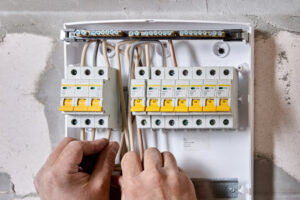

The terms fuse box and consumer unit are often used interchangeably, but there can be important differences between the equipment they describe. Both perform the same basic function, distributing electricity around a property and protecting individual electrical circuits. However, modern consumer units generally incorporate safety features that traditional fuse boxes were not designed to provide.
The main difference between an older fuse box and a modern consumer unit is how electrical faults are detected and the supply is disconnected.
Traditional fuse boxes commonly use replaceable fuses or fuse wire to protect against excessive electrical current. Modern consumer units typically use resettable circuit breakers alongside additional protective devices designed to reduce the risk of electric shock.
For homeowners, understanding these differences is useful when assessing an older property, planning electrical improvements or deciding whether to arrange an inspection.
What does a fuse box or consumer unit do?
Every home needs a central point where the incoming electricity supply is distributed to its various circuits.
These circuits may supply different parts of the property, including lighting, plug sockets, kitchen appliances and heating equipment.
The fuse box or consumer unit provides a way to control and protect these circuits. Its protective devices disconnect the electricity when certain electrical faults occur.
Without suitable protection, excessive electrical current could cause cables to overheat, potentially damaging equipment or creating a fire risk.
For example, consider a socket circuit supplying several appliances. If a fault causes excessive current to flow, the protective device should disconnect the circuit before the wiring is subjected to dangerous conditions.
Both traditional fuse boxes and modern consumer units are designed to provide this essential protection.
The important distinction is that modern equipment can provide additional protection against different types of electrical faults.
How does a traditional fuse box work?


6
Older fuse boxes commonly contain rewireable fuses or cartridge fuses.
A rewireable fuse contains a short length of specially rated wire. If excessive current flows through the circuit, the wire heats up and melts, breaking the electrical connection.
Once the fuse has operated, the circuit remains disconnected until the fuse wire has been replaced.
Cartridge fuses work on a similar principle, except the fuse element is enclosed within a replaceable component.
These devices can provide effective protection against excessive current when correctly selected and maintained.
However, traditional fuses have limitations.
Fuses primarily protect against excessive current
A traditional fuse is designed to operate when current exceeds the level it is intended to carry for a sufficient period.
This provides protection against overloads and short circuits.
However, it does not provide the additional shock protection offered by a residual current device.
An electrical fault involving a comparatively small leakage of current to earth may not produce enough current to operate a conventional fuse.
Restoring power requires replacing the fuse
Unlike modern circuit breakers, traditional fuses cannot simply be reset after operating.
The failed fuse must be replaced with a correctly rated component, or the fuse wire replaced where that type is used.
Incorrect fuse ratings can compromise the protection provided to the circuit.
Homeowners should not attempt to repair damaged fuse equipment or improvise replacements.
If fuses repeatedly operate, the underlying cause should be investigated rather than simply replacing them.
How does a modern consumer unit work?


5
Modern consumer units perform the same distribution and circuit-protection functions as traditional fuse boxes, but generally incorporate more sophisticated protective devices.
The exact arrangement varies depending on the design and age of the installation.
Miniature circuit breakers
Miniature circuit breakers, commonly called MCBs, protect circuits against overloads and short circuits.
Instead of using fuse wire that must be replaced, an MCB operates a switching mechanism when the relevant fault conditions occur.
Once the fault has been identified and corrected, the breaker can usually be reset.
This makes restoring power more convenient, although a breaker that repeatedly trips should not be continually reset without investigating the cause.
Residual current devices
Residual current devices, or RCDs, provide an additional level of protection against electric shock.
An RCD monitors the electrical current flowing through the conductors of a circuit.
Under normal conditions, the current flowing out should balance the current returning.
If a difference is detected, it can indicate that current is escaping through an unintended path, potentially including a person.
The RCD is designed to disconnect the supply rapidly when the imbalance reaches its operating threshold.
An RCD cannot prevent every electrical injury, but it provides protection against certain faults that conventional fuses and MCBs cannot detect.
Residual current circuit breakers with overcurrent protection
Some consumer units use RCBOs.
An RCBO combines the functions of an MCB and an RCD within a single protective device.
It therefore provides both overcurrent protection and residual current protection for an individual circuit.
One practical advantage is improved separation between circuits.
For example, in an installation where several circuits share one RCD, a fault affecting one circuit may disconnect power to the others.
With appropriately designed individual RCBO protection, a fault on one circuit is less likely to interrupt unrelated circuits.
This can be particularly useful where a property has several electrical circuits serving different rooms and appliances.
Fuse box vs consumer unit: What are the main differences?
The following comparison illustrates the typical differences between a traditional fuse box and a modern consumer unit.
| Feature | Traditional fuse box | Modern consumer unit |
|---|---|---|
| Circuit protection | Rewireable or cartridge fuses | MCBs or RCBOs |
| After an overcurrent fault | Fuse requires replacement | Breaker can generally be reset once the fault is resolved |
| RCD protection | Often absent | Provided where required by the installation design |
| Shock protection | Primarily relies on other protective measures and fault disconnection | Additional protection through RCDs or RCBOs |
| Circuit separation | Depends on the original arrangement | More flexible arrangements available |
| Enclosure | Older materials and designs vary | New domestic units generally use non-combustible enclosures |
| Additional protection | Often limited | May incorporate surge protection and other devices |
These are typical characteristics rather than absolute rules.
Some older consumer units already incorporate circuit breakers and RCD protection. Likewise, the condition and safety of an installation cannot be established simply by looking at the enclosure.
How can you tell whether your home has an old fuse box?
Homeowners can often identify the general type of equipment by examining its visible features without opening any protective covers.
Traditional fuse boxes may have individual removable fuse carriers rather than rows of small switches.
Some older installations contain ceramic fuse holders or distinctive coloured carriers.
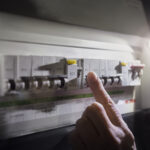
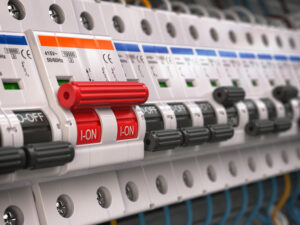
Modern consumer units generally have a row of switches, often accompanied by clearly labelled circuits and one or more test buttons.
A button labelled “T” or “Test” may indicate the presence of an RCD or RCBO.
However, appearances can be misleading.
An older board may have been modified or fitted with replacement protective devices, while a comparatively modern-looking unit may not provide all the protection expected of a newly installed system.
The most reliable way to establish what protection is present is through professional inspection.
Homeowners should never remove the consumer unit cover or expose internal electrical components to identify the equipment.
Does an old fuse box automatically need replacing?
Not necessarily.
Although modern consumer units offer significant advantages, the age or design of an existing fuse box does not automatically mean that it is unsafe or must be replaced immediately.
Guidance published by Electrical Safety First recognises that existing consumer units do not necessarily require replacement simply because they contain traditional fuses, lack integral RCD protection or have an older enclosure design.
The important consideration is whether the installation is safe for continued use and whether suitable protective measures are present.

electricalsafetyfirst.org.uk
+1
An older fuse box may continue providing satisfactory overcurrent protection while other parts of the installation require improvement.
Equally, a board that appears to be functioning normally could contain deterioration or safety concerns that are not immediately visible.
This is why replacement decisions should be based on the condition of the equipment and the installation as a whole.
When might upgrading be appropriate?
An electrician may recommend upgrading a fuse box or consumer unit when an assessment identifies concerns such as:
- Damaged or deteriorating equipment
- Evidence of overheating
- Insufficient protective measures for the circuits concerned
- Difficulty obtaining suitable replacement components
- Inadequate circuit arrangements for proposed electrical work
- A need for additional circuits or protective devices
The appropriate solution depends on the findings.
In some cases, improvements may be possible without replacing the entire unit. In others, installing a modern consumer unit may be the most practical approach.
The decision should reflect the safety requirements of the property rather than simply the age of the equipment.
Why does the rest of the electrical installation matter?
Replacing a fuse box does not automatically resolve problems elsewhere in the property’s wiring.
This is particularly important in older homes where the electrical installation may have undergone alterations over many years.
An electrician needs to consider whether the existing circuits are suitable for connection to the proposed new equipment.
For example, a modern consumer unit incorporating RCD protection may reveal existing insulation or earth leakage problems that previously went unnoticed.
Installing the new equipment without properly assessing these conditions could result in circuits disconnecting repeatedly.
The same principle applies to earthing and bonding arrangements.
These are important parts of the electrical installation and may need assessment before a consumer unit replacement can be completed safely.
Big Fish Electricians provides consumer unit replacements alongside electrical inspection, testing and fault finding for properties around Portsmouth and Fareham.
The business confirms that an assessment of the existing installation may be necessary before a quotation can be provided, particularly where additional work could be required to complete the upgrade safely.
This approach helps establish the actual scope of the work instead of assuming that replacing the visible equipment is the only requirement.
Can a modern consumer unit make future electrical improvements easier?
A suitable consumer unit can make it easier to plan electrical improvements, although the capacity and condition of the existing installation still need to be considered.
For example, a homeowner renovating a kitchen may want dedicated circuits for new appliances.
Someone converting a garage into a home office may need additional sockets and lighting.
A homeowner planning an EV charger installation may require a separate circuit and protective devices suited to the charger.
In each situation, the electrician needs to assess how the proposed work will integrate with the existing installation.
A consumer unit with appropriate space and protective arrangements may simplify some additions.
However, spare positions in the board do not automatically mean that the electrical supply or existing circuits can accommodate additional demand.
A proper assessment is still necessary.
Planning these requirements before undertaking substantial building work may also reduce the likelihood of further disruption later.
What should happen before a fuse box is upgraded?
Replacing a consumer unit involves more than removing the old equipment and connecting a new enclosure.
The electrician will normally need to assess the existing installation, determine the protective devices required and identify any issues that could affect the replacement.
Electrical testing is an important part of this process.
The installation must be suitable for the proposed work, and relevant checks are required before the new equipment is put into service.
Where additional remedial work is identified, this should be explained to the homeowner.
Following installation, appropriate inspection, testing and certification are required.
A consumer unit replacement in a dwelling in England is also notifiable electrical work under the applicable Building Regulations arrangements.
Using an electrician who can explain the necessary testing, certification and notification requirements helps homeowners understand what the finished work includes.
Frequently Asked Questions
Is a fuse board the same as a fuse box?
Yes, in everyday language the terms are commonly used interchangeably. Both can refer to the equipment that distributes electricity to a property’s circuits. The term consumer unit is also frequently used to describe the same general equipment, including older designs.
Is a modern consumer unit safer than an old fuse box?
A modern consumer unit can provide additional protection, including RCD or RCBO protection against certain electric shock risks. However, the safety of a property depends on the complete electrical installation, not simply the type of board fitted.
Can an old fuse box have circuit breakers?
Yes. Some older consumer units contain circuit breakers rather than traditional fuses. They may still lack other protective features commonly included in modern installations.
Will replacing a consumer unit mean rewiring the house?
Not automatically. Existing circuits may be suitable for reconnection after appropriate assessment and testing. If the wiring has defects or is unsuitable for the proposed protective arrangements, additional remedial work may be necessary.
Do modern consumer units prevent electrical fires?
They can reduce certain electrical risks through appropriate protective devices and enclosure design. However, no consumer unit can eliminate every possible cause of electrical fire. Correct installation, suitable wiring and continued maintenance remain essential.
Understanding which protection your home needs
The difference between a fuse box and a modern consumer unit is not simply a matter of terminology.
Traditional fuse boxes primarily rely on fuses to provide protection against excessive electrical current. Modern consumer units can incorporate circuit breakers, RCDs and RCBOs that provide additional protection against different types of faults.
These improvements can make modern consumer units a worthwhile upgrade, particularly where an existing installation lacks appropriate protective measures or needs to accommodate additional electrical work.
However, an older fuse box should not automatically be condemned because of its age. The sensible approach is to assess its condition, the protection it provides and the wider installation before deciding whether replacement is necessary.
If you have an older fuse box or are considering a consumer unit upgrade, Big Fish Electricians can assess your existing installation and advise on the most appropriate next steps.
Phone: 07789 214528 Email: mike.thomas@bigfishea.co.uk Find out more: https://bigfishea.co.uk/